
The Carnal Christian, Lessons from David and the City of Keilah
Bob Yandian
Psalm 36 was written during one of the most revealing times in David's life. The background for this psalm is found in 1 Samuel 23, where David came to the city of Keilah after delivering its people from the Philistines. At first glance, the people appeared to love God and appreciate what David had done for them. They welcomed him, praised him, and seemed to stand with him. But the Lord revealed something David could not see with his natural eyes. Beneath their words was carnality.
The people of Keilah were believers, but they had become controlled by fear. Saul's continual threats had caused them to trust in themselves instead of trusting in the Lord. They feared Saul more than they feared God, and although they treated David kindly on the surface, they were prepared to hand him over to Saul if it meant saving themselves.
This became the setting for Psalm 36. David was not simply writing about unbelievers. He was writing about believers who had turned from dependence on the Lord to dependence upon the flesh. The psalm becomes one of Scripture's clearest descriptions of the carnal believer.
Carnality Can Happen to Any Believer
Understanding the carnal Christian is important because carnality is not limited to one period of history. It existed throughout the Old Testament, continued into the New Testament, and still exists today. A carnal Christian is still born again. The Holy Spirit still lives inside him. The difference is that the Holy Spirit is no longer controlling his life because unconfessed sin has placed the believer under the control of the flesh.
The remedy has never changed. First John 1:9 was written to believers, not to unbelievers. Salvation comes through faith in Jesus Christ, but fellowship is restored through confession of sin. When believers confess their sins, God is faithful and just to forgive them and to cleanse them from all unrighteousness. Fellowship is restored, and the Holy Spirit once again directs their lives.
David understood this from experience. There had been times when he himself became carnal. During his flight from Saul, before arriving at the cave of Adullam, David trusted his own reasoning instead of God's promises. Later, during the sin involving Bathsheba and the murder of Uriah, he again entered a prolonged period of carnality. David knew both the misery of living outside fellowship with God and the joy of restoration through repentance. Because of those experiences, David recognized carnality when he saw it in others.
The people of Keilah were outwardly friendly, but inwardly they had already decided they would betray David if Saul arrived. David could not discern this through observation alone. The Lord revealed their hearts.
Before long, Abiathar the priest arrived carrying the ephod. Since the ark was unavailable during this period, the ephod became the means through which David sought the Lord's direction. Rather than acting impulsively, David inquired of the Lord concerning two questions. Would Saul come to Keilah? Would the people surrender him to Saul? The answer to both questions was yes.
David had men watching the countryside who could report what they saw, but only the Lord knew the intentions hidden within men's hearts. Human observation could never reveal what only God could know. Although the people praised David publicly, they were already planning to preserve themselves at his expense. David immediately departed with his men, avoiding the trap altogether.
Carnality Begins on the Inside
The contrast between David and Saul becomes striking throughout this account. David sought the Lord before acting. Saul acted according to his own reasoning while using God's name to justify his decisions. Saul even convinced himself that God had delivered David into his hand because Keilah was surrounded by gates and walls. Carnality often leads people to interpret circumstances according to their own desires instead of according to God's Word.
At this point Saul was completely controlled by his flesh. Yet Saul remained a believer. This often surprises Christians, but Scripture teaches that Saul belonged to the Lord even while living in rebellion. Before Saul's death, Samuel declared that Saul and his sons would be with him the following day. Saul would enter heaven, but he would die in carnality.
This illustrates an important truth. Carnality does not cancel salvation, but it does rob believers of fellowship, usefulness, joy, and eternal reward.
Psalm 36 begins by exposing the thinking of the carnal believer. David writes that transgression speaks within the heart of the wicked because there is no fear of God before his eyes. In this psalm, the wicked are not unbelievers but believers living under the control of the flesh. Carnality begins on the inside before it ever becomes visible on the outside.
The believer begins listening to himself instead of listening to the Lord. Pride replaces humility. Self-preservation replaces dependence upon God. Before long, every decision is filtered through personal advantage instead of divine wisdom.
David observed that the words of the carnal believer become filled with deceit. The people of Keilah praised David while secretly planning to betray him. Their speech sounded spiritual, but it no longer reflected hearts controlled by the Holy Spirit. This remains true today.
A carnal believer may still know the right language. He may speak about the Lord, quote Scripture, and sound mature. But eventually the flesh reveals itself. Carnality cannot remain hidden forever. Sooner or later, bitterness, pride, fear, selfishness, or anger begins to appear.
God's Word Produces Stability
David also observed that these believers had ceased to be wise. There had once been a time when they understood God's Word. There had been depth in their lives. They possessed genuine love, genuine faithfulness, and true concern for others. Now those qualities had disappeared because they were no longer walking under the control of the Spirit. Neglect of God's Word always produces spiritual decline.
When believers stop depending upon the Lord, they begin producing what Scripture calls human good instead of divine good. Their works may appear impressive outwardly, but they originate from the flesh rather than from fellowship with God.
Paul described these two kinds of works in First Corinthians chapter three. Divine production is compared to gold, silver, and precious stones. Fleshly production is compared to wood, hay, and stubble. Both may appear valuable now, but only one survives the judgment seat of Christ.
The people of Keilah were operating entirely through human effort. Fear controlled every decision. Their concern was not for God's plan but for their own survival.
David recognized another characteristic of carnality. The carnal believer devises wickedness upon his bed. His thoughts continually revolve around himself. Instead of meditating on God's promises, he lies awake planning how to protect himself, justify himself, or gain advantage over others.
The men of Keilah were not planning how to honor the Lord. They were planning how to deliver David to Saul.
Carnality always turns attention inward. Spirituality directs attention toward the Lord. David understood that mature believers genuinely love other people because the Word of God has produced stability within them. Carnal believers become superficial. They may speak kindly for a season, but their words lack depth because they no longer flow from fellowship with God. Their outward appearance may seem convincing, but eventually the flesh becomes impossible to hide.
God's Grace Is Greater Than Your Failure
David does not end Psalm 36 by concentrating on the carnality of the people of Keilah. Instead, he turns his attention to the character of God. This is always the answer when believers are surrounded by carnality. We cannot overcome the flesh by studying the flesh. We overcome it by fixing our attention on the Lord.
David begins by declaring, "Your mercy, O Lord, is in the heavens, and Your faithfulness reaches to the clouds." God's grace is greater than man's failures. His mercy extends farther than human weakness. The men of Keilah trusted in themselves, but David trusted in the Lord. They believed they had to preserve themselves, while David knew his life rested safely in God's hands.
David had already learned that assurance comes from knowing God's power. Earlier, while seeking the Lord concerning Keilah, David reflected on the resurrection of Jesus Christ. If God could raise His Son from the dead, then no circumstance David faced could ever be greater than God's power. The resurrection required the greatest display of God's power recorded in Scripture. Compared to that, every trial, every enemy, every financial problem, every accusation, and every danger is small.
When believers compare their problems to themselves, those problems appear overwhelming. When they compare their problems to the resurrection of Jesus Christ, those same problems become opportunities for God to demonstrate His faithfulness.
David continues by saying, "Your righteousness is like the great mountains." Mountains represent permanence and stability. They existed long before David arrived and would remain long after he departed. In the same way, God's righteousness existed before man was created and will continue forever. Grace rests upon the foundation of God's righteousness. God is never gracious because He ignores righteousness. He is gracious because His righteousness has been fully satisfied.
This gives stability to the believer. Human kindness without righteousness becomes sentimentality, but God's grace always rests upon His perfect character.
Maturity Means Greater Dependence
David then declares that God's judgments are like a great deep. God's wisdom is beyond human understanding. His purposes cannot be fully searched out. Man often wants immediate explanations, but God's plan stretches far beyond what natural thinking can comprehend.
David had just witnessed this truth in Keilah. At first he believed the people were loyal. God revealed otherwise. Human observation failed, but God's wisdom never failed.
He also declares, "You preserve man and beast." God watches over His creation. He delivers His people because of His own character, not because of theirs. David understood that his safety did not depend upon the loyalty of Keilah. His safety depended upon the Lord.
He then writes, "How precious is Your lovingkindness, O God. Therefore the children of men put their trust under the shadow of Your wings." Throughout Scripture, the shadow of God's wings speaks of protection. Just as a mother bird covers her young, the Lord watches over those who trust Him.
David understood something many believers struggle to learn. Maturity never produces independence from God. Instead, maturity produces greater dependence upon Him. The longer believers walk with the Lord, the less they trust themselves and the more they trust Him.
The people of Keilah thought they could preserve themselves through compromise. David knew his preservation rested entirely upon God. This is the difference between spirituality and carnality. The spiritual believer continually depends upon the Holy Spirit. The carnal believer continually depends upon himself.
David then prayed, "Continue Your lovingkindness to those who know You, and Your righteousness to the upright in heart."
His concern was never limited to himself. David always desired God's blessings to rest upon those who faithfully followed Him. Throughout his life, David continually demonstrated concern for those who served alongside him. Even while running from Saul, he remained committed to protecting the men God had entrusted to him. This same attitude marks spiritual maturity. Carnality focuses inward. Spirituality looks outward.
The Answer Has Never Changed
David also prayed, "Let not the foot of pride come against me." Saul represented pride throughout this account. He refused to yield to God's plan. Rather than accepting God's choice of David, Saul fought against it. He believed he was resisting David, but in reality he was resisting the will of God. Pride always produces conflict with God's plan. Humility submits to it.
David knew God would preserve him as long as he continued depending upon the Lord's promises. Saul could gather armies, devise strategies, and pursue David from city to city, but he could never overturn what God had already determined.
This remains true for every believer today. Circumstances may appear overwhelming. The enemy may seem to have the advantage. Yet God's purposes cannot fail. His promises remain secure because they rest upon His character rather than ours.
The final verses of Psalm 36 anticipate the ultimate defeat of those who oppose God's plan. David declares that the workers of iniquity have fallen. Although Saul still occupied the throne, David already knew the outcome. God's Word had settled the issue. Faith always sees beyond present circumstances.
Looking back over Scripture, David's experience at Keilah was not unique. Carnality appears repeatedly throughout the Bible, proving that believers have always faced the choice between living by the flesh or living by faith.
After the flood, Noah became drunk and fell into carnality. Yet God restored him. Abraham twice attempted to save his own life by giving Sarah to foreign rulers. Fear replaced faith, yet God remained faithful to His covenant. Jacob spent years manipulating circumstances through his own wisdom before finally surrendering himself to the Lord. Moses attempted to fulfill God's calling through human strength by killing an Egyptian. Only after forty years in the wilderness did he learn complete dependence upon God.
King Saul provides one of the clearest examples of prolonged carnality. Although he remained a believer, he continually resisted God's will until his death on Mount Gilboa.
Even the disciples struggled with carnality. They argued over who would be greatest. They fled when Jesus was arrested. Peter later separated himself from Gentile believers at Antioch out of fear, requiring public correction from Paul.
Each of these examples demonstrates the same truth. Believers can fall into carnality, but God always provides the way back. The answer has never changed.
Fellowship Brings Stability
When believers confess their sins, God restores fellowship. The Holy Spirit again assumes His rightful place of leadership within their lives.
David knew this personally. He had experienced failure. He had experienced restoration. He had experienced the faithfulness of God. That is why Psalm 36 never ends with man's failure. It ends with God's faithfulness.
The people of Keilah chose fear over faith. David chose to trust the Lord. Saul chose pride. David chose humility. The people depended upon their own wisdom. David depended upon God's revelation.
In the end, David escaped safely, not because he was stronger than Saul or wiser than the men of Keilah, but because he sought the Lord and obeyed His direction.
The lesson of Psalm 36 reaches far beyond the city of Keilah. Every believer must decide daily whether to live under the control of the flesh or under the control of the Holy Spirit. Carnality promises security but always produces fear. Spirituality requires faith but always leads to stability.
The Lord has never asked His people to trust their own understanding. He asks them to trust His Word, walk in fellowship with Him, and remain dependent upon His grace.
When believers do that, they discover exactly what David discovered. God's mercy reaches to the heavens. His faithfulness reaches to the clouds. His righteousness stands as firm as the mountains. His protection never fails, and His lovingkindness never departs from those who know Him and continue walking with Him.

Previously published as: Galatians: Spirit Controlled Life
After Paul had initially established churches in Galatia, he received discouraging news. Jews from Jerusalem had come to those Gentile churches and were teaching them to follow Jewish law as a means of salvation. Paul was so disturbed by this report, he wrote to confront the Galatians about their foolishness in turning to dead works after having received the glorious gospel of grace. The Galatian epistle could be called an unsparing manifesto of grace: a strong declaration of faith and faith alone for salvation, faith not based on any effort or observance, but founded solely upon the grace of God.
In this in-depth, verse-by-verse study of Galatians, Bob Yandian defines legalism and its effects upon both ancient Galatians and modern Christians. By outlining how legalism infected the Galatian churches, Yandian also exposes modern legalism and discusses ways to overcome this most subtle of Satan's attacks upon the church of Jesus Christ.
208 pages

The book of Romans clarifies the principle of justification, whether it is by deeds of the law, or by the work of God. The law has never been a means of salvation. Faith has always been the means of spirituality regardless of the dispensation. This epistle also helps us to understand how to have victory over the flesh. If we as believers walk according to our new nature, the inward man, we are controlled by the Holy Spirit and not the sin nature. Romans New Testament Commentary is a verse-by-verse teaching of the book of Romans from the personal study notes of Bob Yandian.
172 Pages
Deepen Your Understanding of Scripture
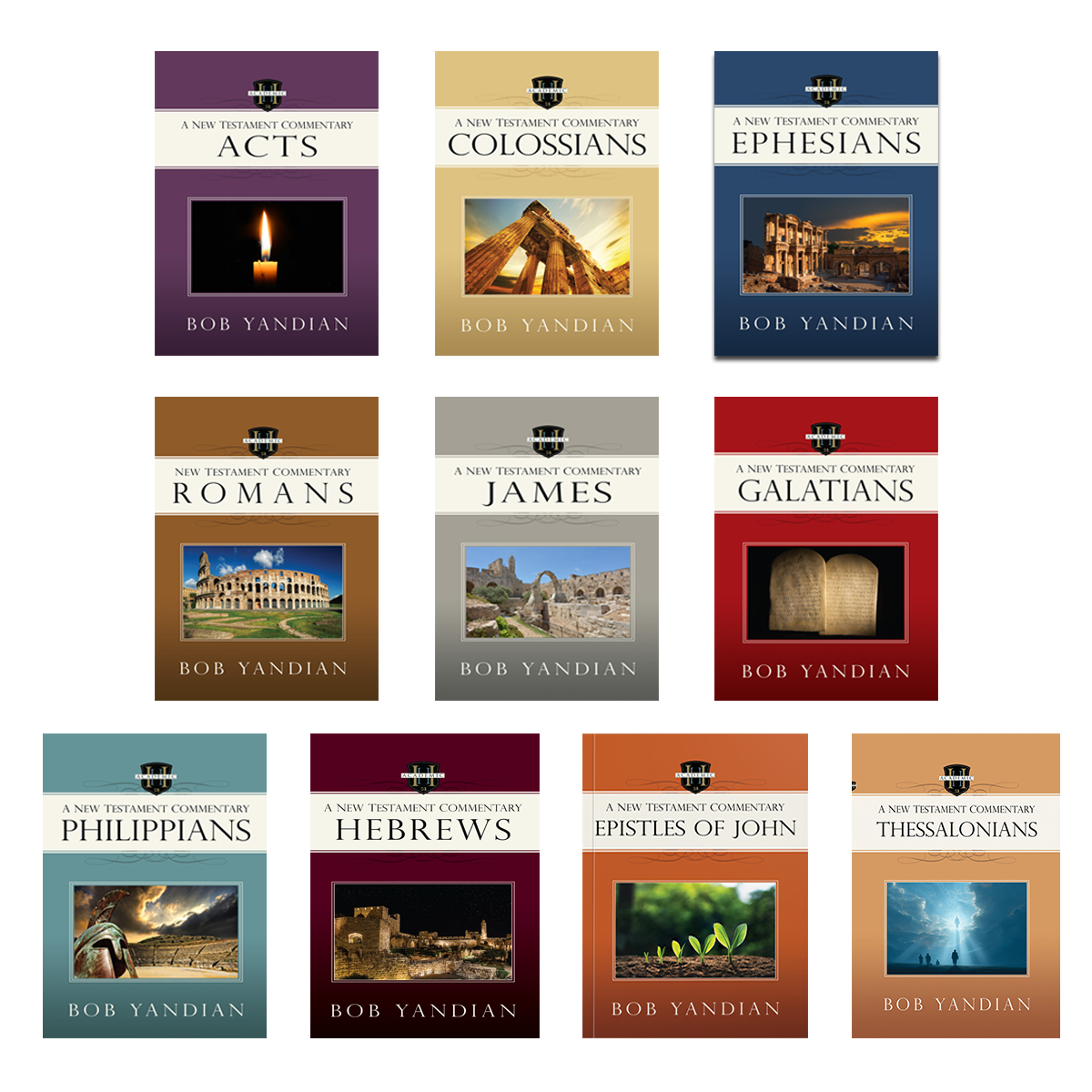
Unlock fresh insight into God’s Word with the New Testament Commentary Bundle from Pastor Bob Yandian — a comprehensive collection of verse-by-verse commentaries on ten foundational New Testament books. Carefully crafted from years of pastoral teaching and study, this bundle equips believers, students, and church leaders with clear explanation, practical application, and spiritual depth.
Purchase this book bundle and save! This bundle includes one of each of Bob Yandian's New Testament Commentary books listed below.
Acts Commentary
Romans Commentary
Galatians Commentary
Ephesians Commentary
Philippians Commentary
Colossians Commentary
James Commentary
Hebrews Commentary
Epistles of John Commentary
New! Thessalonians Commentary