
Living in God’s Rest Through the Power of the Word
Bob Yandian
Worry Is Not an Option for the Believer
Jesus often used the expression, “Take no thought.” What does that mean? A better way of saying it is simply, “Stop worrying!” Jesus wasn’t making a suggestion. He was giving a command.
In 1 Corinthians 7:32, Paul said, “I want you to be without care.” Paul presented this as a desire, but Jesus presented it as a command. He said, “Take no thought.” In other words, don’t worry. Stop it!
We often think of the Ten Commandments and how serious they are. Thou shalt not kill. Thou shalt have no other gods before Me. But Jesus also commanded us not to worry. When you worry, you are putting something ahead of God. You are placing your own thoughts, opinions, and judgments about a situation above what God has already said in His Word.
“Many are the afflictions of the righteous, but the Lord delivers him out of them all” (Psalm 34:19).
Notice that afflictions are promised, but deliverance is also promised. As long as we are living in this fallen world, we are going to have problems. Satan, the world system, and our own flesh will come against us. But God has promised to bring us through. So why should we worry?
Worry Is a Slow Form of Suicide
I like to think of worry this way: worry is a slow form of suicide. It can affect your health, your relationships, and your entire outlook on life. God intends for you to live a long, productive life, but your attitude can affect everything you do. Worry is dangerous to your spiritual life as well as your natural life.
One of the greatest indicators of spiritual maturity is learning to cast your burdens on the Lord. A mature believer reaches the place where he says, “I’m not going to worry about this. God has already made me a promise, and I’m going to trust Him.”
Luke 8:14 tells us that the seed falling among thorns represents those who hear the Word but are choked with cares, riches, and pleasures of life, bringing no fruit to maturity. Notice that worry prevents spiritual maturity. You cannot continue growing in the things of God while constantly allowing your mind to be controlled by anxiety. Worry chokes the Word and keeps it from producing the fruit God intended.
Worry Always Looks Toward the Future
Worry is always concerned about tomorrow. It looks at a situation and begins predicting everything that could go wrong. You remember something that happened before, begin quoting statistics, and convince yourself that the same thing is going to happen again. But worry never stops to calculate everything God has already done for you. The Bible tells us not to forget all His benefits.
One of the greatest things you can do is keep a record of the miracles God has performed in your life. Write down the times He brought you through difficulties. Then, when another problem comes along, look back and remember. You may discover that you have already come through something much bigger than what you are facing today.
Think about salvation. God took you out of Satan’s kingdom and placed you into His own kingdom. He made you a child of God and gave you eternal life. He promised you heaven, a resurrection body, and a wonderful future with Him. If God could do all that, why would He fail you over some momentary problem in life?
Focus on the Answer, Not the Problem
Most of the things people worry about never happen. Think about all the times you imagined something terrible happening, and it never came to pass. Even when a problem does happen, it often isn’t nearly as bad as you expected. And if you can solve some problems with your own natural ability, think about what God can do. You are a human being looking for natural answers. God is supernatural, and He has supernatural answers.
The most important thing you can do as a Christian is learn the Word of God and begin acting on it. Instead of focusing on your problems, focus on the answers. The Word of God is the answer.
Yesterday is gone, and you cannot change it. Tomorrow hasn’t arrived, and you don’t know everything that’s going to happen. But you do know that God will take care of you. Live in the moment, trusting the Lord with your future.
Israel Forgot What God Had Done
Think about the children of Israel. God protected them for four hundred years in Egypt. Then He sent ten plagues, brought them out of bondage, opened the Red Sea, and destroyed the Egyptian army. What tremendous miracles! But when they reached the wilderness and faced another problem, they began complaining.
They said, in effect, “We have finally figured out God’s plan. He brought us out here to kill us!” Think about that. God already promised them the land of Canaan, a land flowing with milk and honey. But they forgot the promises and focused on the desert. They looked around and saw no food, no water, and no natural provision. Their conclusion was that they were all going to die. This is what worry does. It takes your eyes off everything God has promised and puts them on the present circumstances.
Hebrews chapters 3 and 4 explain how unbelief kept that generation from entering God’s rest. The next generation learned to trust God and entered the Promised Land. The difference was faith.
Don’t Be a Double-Minded Believer
The Greek word associated with worry carries the idea of being drawn in different directions. You look at God’s promises, then you look at your problem. You say, “I know God said this, but look at what’s happening!” Then you look back at the Word, and a moment later you are looking at the problem again. Back and forth. Back and forth.
James 1:5–8 describes this as double-mindedness. The double-minded man is like a wave of the sea, driven and tossed by the wind. He is unstable in all his ways. One moment he is trusting God, and the next moment he is worrying. It’s like a fountain that produces fresh water one minute and salt water the next.
You cannot establish a stable Christian life while constantly moving between faith and worry. Make up your mind that the Word of God is true.
Prayer and Thanksgiving Replace Worry
Philippians 4:6 tells us to “be anxious for nothing, but in everything by prayer and supplication, with thanksgiving, make our requests known to God.”
Notice that Paul didn’t say to ignore your problems. He said to pray about them. But prayer must be accompanied by thanksgiving. Why? Because thanksgiving demonstrates that you believe God’s Word will come to pass.
You can say, “Lord, here is the problem I’m facing. But You have already promised to take care of me, and I’m thanking You for the answer.” Then continue living your Christian life. Keep witnessing. Keep praying. Keep studying the Word. Keep doing what God has called you to do. Let God bring you through the situation. He will give you wisdom when you need it.
Consider the Birds and the Lilies
In Matthew 6:25–34, Jesus used nature to teach His disciples about worry.
He told them to consider the lilies of the field. They don’t toil or spin, yet God clothes them more beautifully than Solomon in all his glory. Then Jesus told them to look at the birds of the air. They don’t sow or reap or gather into barns, yet the heavenly Father feeds them.
Jesus was standing outside, teaching people on the side of a hill. He simply pointed to the flowers and the birds around them. Look down at the flowers. Now look up at the birds. God takes care of every one of them.
Then Jesus asked whether we are not of much more value than they are. Think about that. God didn’t send Jesus to die for flowers. He didn’t shed His blood to redeem birds. But He did send Jesus to die for you. If God takes care of flowers and birds, how much more will He take care of His own children?
God’s Supernatural Rest
Rest isn’t simply lying down on a bed. I’m talking about internal rest, rest for your soul and your thoughts. It is the peace that comes from having your spirit and mind filled with the Word of God.
When problems arise, instead of immediately thinking about everything that could go wrong, begin pulling the promises of God out of your memory. It is like opening files on your computer. You have the Word stored inside you. Now bring those scriptures out and begin meditating on them. When you wake up during the night and worrying thoughts begin coming, take those thoughts captive.
Don’t meditate on the problem. Meditate on the Word.
Psalm 1 says the blessed man meditates in God’s law day and night. This is how you become rooted and grounded in the things of God.
Living Above the Circumstances
When you begin trusting God, the supernatural way of life becomes your normal way of life. While everybody else is looking at the circumstances, you are looking at the promises. While everybody else is worrying about tomorrow, you are thanking God for His faithfulness.
You are like that tree planted beside the river. The desert may be dry, and everything around you may be struggling, but your source hasn’t changed. God’s Word is still true. His promises haven’t failed. And the God who has taken care of you every day until now isn’t going to abandon you tomorrow. So quit focusing on the problem and begin focusing on the answer. God wouldn’t command you to be free from worry if it wasn’t possible.
Cast your cares on the Lord. Meditate on His Word, trust His promises, and enter into His supernatural rest. Remember, the God who saved you, delivered you, and gave you eternal life has also promised to take care of you.
Stop worrying and start trusting God.

The clouds of legalism were forming over the church at Jerusalem. Legalism eventually killed the church and it was already hindering the ministries of Peter and Paul who eventually left the Jerusalem church for James to oversee. As pastor of the church, James recognized hypocrisy and legalism infiltrating his congregation. In this book, James is addressing these issues both with his congregation and the Jews who are scattered.
In this commentary taken from his personal notes, Bob Yandian dissects, verse-by-verse, showing the heart of a true pastor and the devastating effects of legalism in the church.
98 Pages

The theme of the book of Philippians is first joy and secondly, partnership. Paul had a vision in Troas of a man from Macedonia calling him to come and preach the gospel. Paul began this ministry in the Roman colony of Philippi. He expresses his thanks and appreciation to the people in Philippi who stood by him as partners with their prayers and financial support.
This verse-by verse teaching through the book of Philippians from the personal study notes of Bob Yandian will give you great insight into the church at Philippi and the topic of God’s joy, which is the strength of our Christian life.
87 Pages
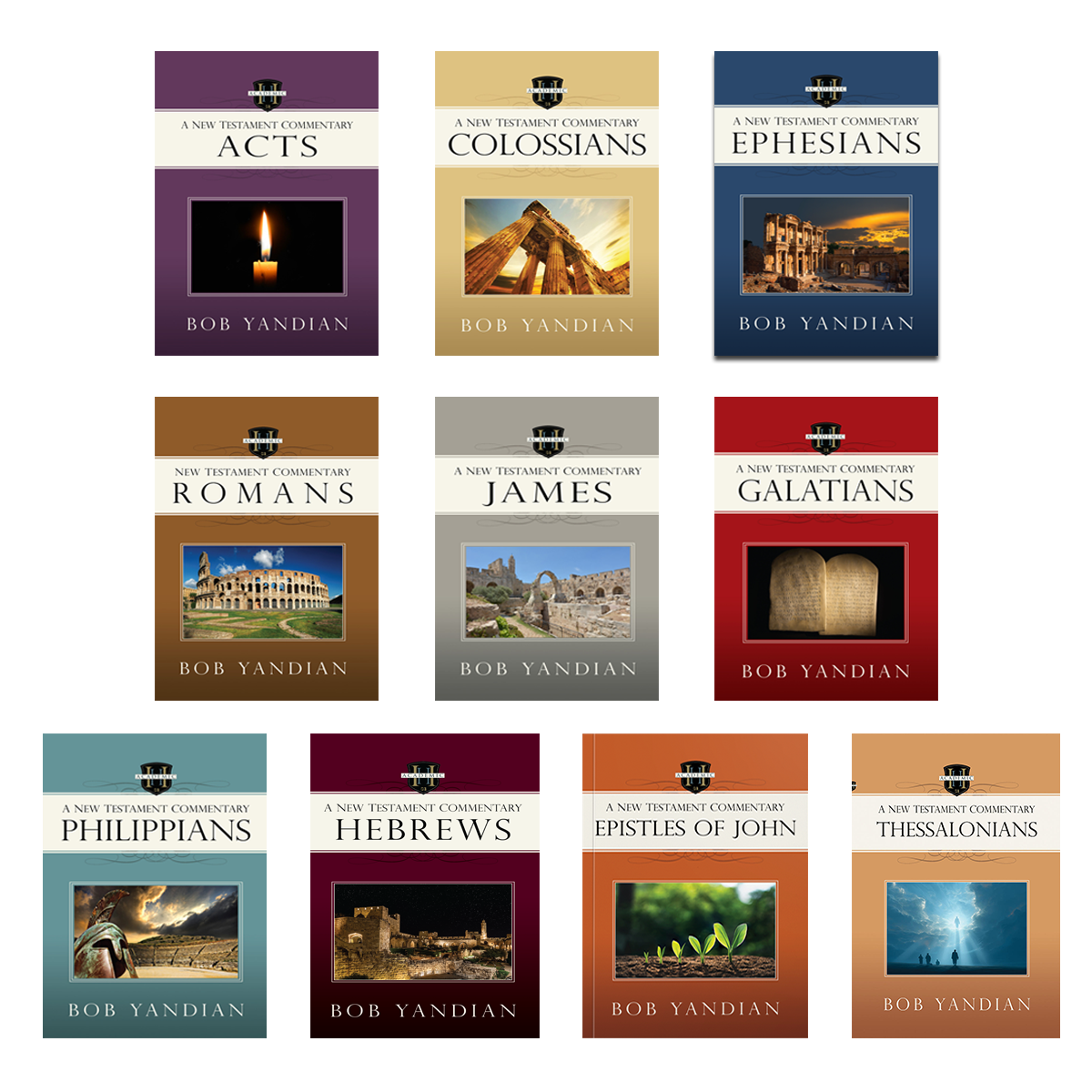
Deepen Your Understanding of Scripture
Unlock fresh insight into God’s Word with the New Testament Commentary Bundle from Pastor Bob Yandian — a comprehensive collection of verse-by-verse commentaries on ten foundational New Testament books. Carefully crafted from years of pastoral teaching and study, this bundle equips believers, students, and church leaders with clear explanation, practical application, and spiritual depth.
Purchase this book bundle and save! This bundle includes one of each of Bob Yandian's New Testament Commentary books listed below.
Acts Commentary
Romans Commentary
Galatians Commentary
Ephesians Commentary
Philippians Commentary
Colossians Commentary
James Commentary
Hebrews Commentary
Epistles of John Commentary
New! Thessalonians Commentary