
The Unchanging Nature of God: Grace, Wrath, and Justice
Bob Yandian
We are living in the dispensation of grace, and we have been for more than 2,000 years. Because of this long period of grace, many Christians have drawn a wrong conclusion. They say, “I don’t really care for the Old Testament. God was different back then. He was harsh. He was angry. He is not like that anymore.” But that simply isn’t true. God has not changed.
The Bible says, “I am the Lord your God, and I do not change” (Malachi 3:6). That is quoted in both the Old Testament and the New Testament. God does not go through personality shifts. He does not evolve. He does not mellow with age. He is the same yesterday, today, and forever.
God does have a temper. He gets angry at sin. That doesn’t mean He is unpredictable. But it does mean He is holy. And holiness reacts to sin. God has moved through different dispensations—different covenants, different time periods—but He is still God. The difference is not in His nature; the difference is in how He deals with man under each covenant.
In the Old Testament we see many examples of God’s anger when sin reaches a boiling point. Some examples are the flood, Sodom and Gomorrah, the disobedience of the Israelites. There is sacrifice and there is mercy. By the time we come to the New Testament, it seems God has changed. But He has not changed. The vengeance and wrath of God have simply been delayed during the Church Age.
The Delay of Wrath in the Church Age
For over 2,000 years, the world has been rejecting Jesus Christ while standing side by side with those who accept Him. The rain falls on the just and the unjust. God’s grace is extended to both. But grace is not infinite suffering. God is called long-suffering. He is not called infinite-suffering.
There will come a day when the Church is taken out of this earth. When that happens, the Tribulation will begin. And just as God stood up against Pharaoh in Egypt, He will stand up again against a Christ-rejecting world.
In Egypt, God poured out ten plagues. But the children of Israel were protected. That is a beautiful example of how God operates. His wrath was poured out on the Egyptian people, but His people were sheltered.
During the Tribulation, the wrath of God will be poured out on the nations who have rejected Him. Yet even then, it will be a time of the greatest evangelism the world has ever seen. God will still give opportunity to repent. God’s wrath is not random. It is judicial. It is holy. It is measured. It is the response of a righteous God to persistent rebellion.
The Controversy of Joshua
Perhaps no Old Testament book demonstrates this more clearly than the Book of Joshua. And there has been more controversy over Joshua than almost any other historical book in the Bible. Liberal theologians say, “How could God be so angry toward those poor innocent people in Canaan?” They were not poor innocent people.
God gave them time—just as He gave Egypt 400 years. The occupants of Canaan were given 440 years before Israel came into the land. They had opportunity after opportunity to repent. Only one did. Rahab the harlot. When the spies entered Jericho, Rahab believed in the God of Israel. She and her family were spared. That proves something: judgment was not about race; it was about rejection.
In Joshua 9, the Gibeonites deceived Joshua into making a treaty. Joshua honored that covenant even after discovering the deception. Then in Joshua 10, he defended Gibeon against five Amorite kings. During that battle, Joshua commanded the sun and the moon to stand still. The Amorites worshiped the sun and moon. Joshua demonstrated that the God of Israel had authority over their gods. Many Christian commentaries doubt this miracle. They say nature is self-contained, impervious to intervention. But throughout Scripture, God intervenes in nature. He created it. He controls it. And at times, He turns authority over it to man.
Joshua 10 and 11 record the southern and northern conquests of Canaan. These campaigns lasted six to seven years. Entire populations were destroyed. Philosophical and liberal religious leaders accuse God of being a brute, a bully, a killer. But the Bible says, “Behold both the goodness and the severity of God” (Romans 11:22).
Goodness and Severity
We often over-amplify God’s love and ignore His other attributes. But God’s mercy and God’s wrath are both as real as His love. God’s grace and God’s vengeance are just as real as His love. God’s goodness and God’s severity are as real as His love.
Hebrews 1:9 says of Jesus, “You have loved righteousness and hated lawlessness.” Heaven applauded Him for loving righteousness and hating sin. If Jesus loved righteousness and hated iniquity, perhaps it’s time the Church does the same.
When governments call evil good and good evil, it is time for believers to stand up. God applauds righteousness. He does not applaud compromise. God’s holiness is as real as His grace. God’s justice is as real as His mercy.
Discipline and Wrath
There is a difference between discipline and wrath. Believers will never experience the wrath of God. We have not been appointed unto wrath. But we can experience discipline. Romans 6:1 says, “Shall we continue sin that grace may abound? Certainly not!” Daily living grace can be exhausted. There can come a time when God says, “I have been gracious. I have been merciful. I have been long-suffering. But this is where it ends.” It is like raising children. You warn them. You talk to them. You give them opportunity after opportunity. But if they persist, discipline follows.
The world has the idea it can control God. Sadly, some carnal Christians think the same way. But God cannot be manipulated. In the Old Testament, Israel was disciplined with 70 years of captivity in Babylon. They were not annihilated. They were corrected. A remnant returned and from that time forward, they never returned to idol worship. Wrath toward the unbeliever is unlimited in its eternal consequences. Discipline toward the believer is corrective and temporary.
The Coming Outpouring
During the Tribulation, a quarter of the world’s population will die at one point. With eight billion people today, that would be two billion people. At the Battle of Armageddon, Jesus Himself will destroy the armies that come against Jerusalem. Revelation describes blood running to the horse’s bridles for 185 miles. That is not sudden. That is the result of years and years of rejection. Sin builds. Rebellion grows. Finally, it reaches a boiling point. If God did not intervene, Satan would annihilate His people. Wrath is not only anger against evil; it is protection of righteousness.
Because we are living in the Church Age we are living under grace. But grace does not mean passivity. Romans 8:31 asks, “What shall we say to these things?” These things include famine, war, persecution, and sickness. What do we say? “If God is for us, who can be against us?”
God has given us authority in the name of Jesus. It is not every day we speak to demons or sickness. But when we confront them, we have authority. Joshua spoke to the sun and moon under divine authority. We speak to circumstances under the authority of Jesus.
Judgment Seats
Believers will stand before the judgment seat of Christ. Our works will be judged. Some will receive great rewards. Others will receive fewer rewards. But we enter heaven because we accepted Jesus Christ as Lord and Savior. Unbelievers will stand before the great white throne. They will be judged for one thing: rejection of Jesus Christ. Those whose names are not found in the Book of Life will be cast into the lake of fire. The only prerequisite for heaven is faith in Jesus Christ. Rewards are based on obedience.
God still has anger inside of Him. You and I will never draw His wrath. But we should understand it. There came a time for divine judgment in Joshua’s day. There is coming a time for divine judgment again. Until then, behold both the goodness and the severity of God.
Love righteousness. Hate iniquity. And be thankful—deeply thankful—that we are living in the dispensation of grace.

Previously published as: Ephesians Blueprint for Maturity
Although the city of Ephesus is famous for its reckless living and idol worship, the Ephesian church is deeply spiritual. And so Ephesians, unlike other epistles written to correct doctrinal error, reveals to mature believers the positional truth of who they are in Christ. It also expounds on practical applications of this positional revelation to marriage, family, and everyday life.
By tying together Greek word studies and outside scriptural references, Bob Yandian teaches, verse-by-verse, God’s empowering grace and the believer’s unprecedented authority. Like Paul, Yandian’s focus is not only the revelation, but the application of these amazing truths. Yandian exhorts believers not only to learn but to live as the body of Christ in the earth.
143 Pages

Revealing God’s Heart to Heal
Why does God heal some people but not others? Do you have questions about divine healing? How does it work? What is required? How much faith is necessary?
In The Grace of Healing, pastor, author, and renowned Bible teacher Bob Yandian answers these questions while revealing the missing ingredient to the healing you’ve been praying for—grace!
Over the course of church history, the doctrines of grace and faith have been taken to separate extremes as they relate to healing. The result is that many believers struggle to understand or receive healing from God. Those on the side of grace deny the need for faith, believing that God only heals a select few. For those who only see a need for faith, the pursuit of healing becomes a legalistic struggle to change God’s mind.
But Pastor Bob takes a different approach, offering practical and straight-to-the-point biblical teaching that balances the elements of grace and faith—so your health can spring forth speedily.
You’ll find the healing you’ve been waiting for when you find the missing ingredient of grace!
176 Pages
Paperback
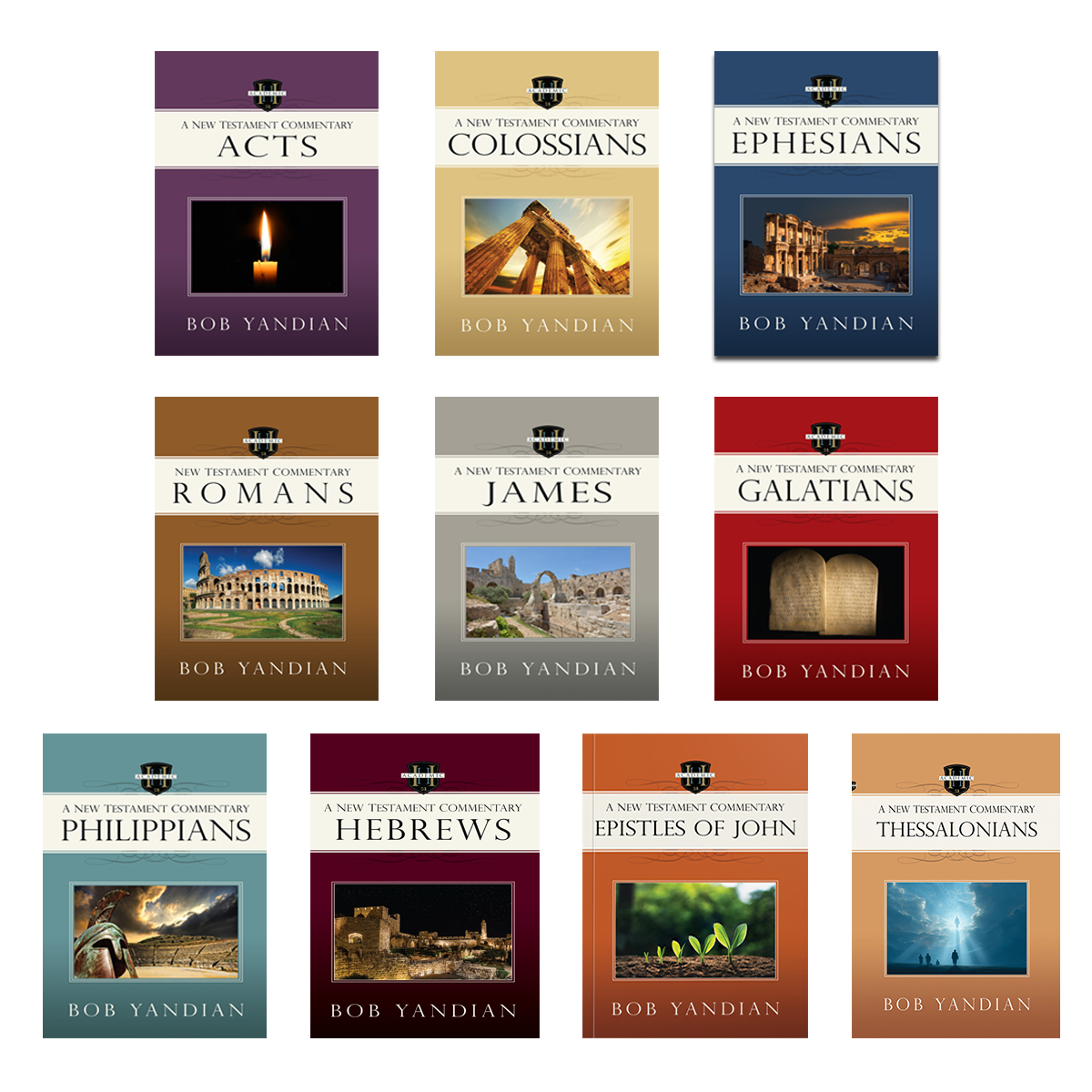
Deepen Your Understanding of Scripture
Unlock fresh insight into God’s Word with the New Testament Commentary Bundle from Pastor Bob Yandian — a comprehensive collection of verse-by-verse commentaries on ten foundational New Testament books. Carefully crafted from years of pastoral teaching and study, this bundle equips believers, students, and church leaders with clear explanation, practical application, and spiritual depth.
Purchase this book bundle and save! This bundle includes one of each of Bob Yandian's New Testament Commentary books listed below.
Acts Commentary
Romans Commentary
Galatians Commentary
Ephesians Commentary
Philippians Commentary
Colossians Commentary
James Commentary
Hebrews Commentary
Epistles of John Commentary
New! Thessalonians Commentary